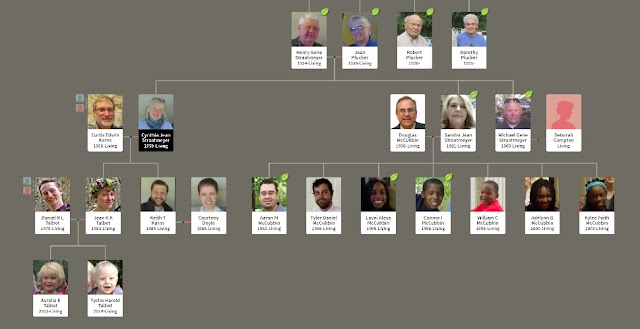
Henry Gene Straatmeyer's family tree (WIBBEN SIDE)
WIBBEN
GREAT GRANDFATHER AND GREAT GRANDMOTHER: After coming to the United States, they lived at Ridot, Illinois. Geerd Wibben was born 7.21.1845 (The Loquard Church book says his name is Gerd Claassen Wibben and he was born on 6.21.1845) and baptized in the parsonage on 6.29.1845 in Loquard, Ostfriesland. Then it says his father was Hilke Garrelts and wife Jan Eggerkes – I don’t understand this). His mother's name is listed as Anna Harms. He married Metje Bentheim (There are Bentheims in the Loquard church book but no Metje) in Stephenson County, Illinois on March 11, 1872. Metje had a four year old daughter when they married. They had six children together. My grandmother, Anna, was the first of the children of this marriage, born on May 18, 1872, two months after their marriage. It is believed that Metje died around January 4, 1883 during or after the birth of Fraukelina Katavina and the child was raised by Berend and Elina Miller. It is believed that Elina was Metje's sister. It is interesting that my grandmother Anna also died in the childbirth of Arnold, and my grandfather, Henry, facing the same situation as his father-in-law before him, gave Arnold to another Straatmeyer family. Later, when Henry's daughter Gertie Binger would die of the complications following childbirth, my grandfather and my step grandmother took the month old baby, Art Binger, to raise him. It was how they handled things in those day – relatives adopted family children who needed a home.
On 9.18.1883 Geert Wibben married Miss Trientje Alberts Stratemeyer who was 29 years old. Her birthplace was also listed as Loquard, Ostfriesland and she was born 12.21.1855. Her father's name was Brunke Siebold Straatmeyer and her mother's name was Geeske Wagenaar. Married by a Justice of the Peace in Freeport, Illinois, Geerd was 38 years old and they had six children, one son died in infancy. From Ridott, they moved to Dalton, South Dakota.
I have a copy of their farm sale advertisement. "The undersigned will sell the following described property on his farm located one and one-half mile north of Dolton and six miles east and two miles south of Bridgewater on Thursday, January 17th, 1918 commencing at 11 a.m. They had 11 horses, 9 milch cows, one heifer, one steer, two yearling calves and 100 chickens. The machinery included 3 box wagons, 2 hay racks, 8 foot Deering binder, Deering mower, sweep rake, hay rake, 14 inch gang plow, 16 inch sulky plow, 16 inch walking plow, 2 riding cultivators, 2 ride or walk cultivators, garden cultivator, 2 Moline discs, Moline corn planter, with 160 rods of new wire, 11 foot Success drill, 11 foot Broadcast seeder, 2 harrows, 2 top buggies, set of sleigh runners, bob sled, 1 small sleigh, 1 DeLaval cream separator; 1 water tank, 1 barrel cart, 3 hog troughs, hog chute, fanning mill, grind stone, 3 scoop boards, scoops, forks, 4 sets of work harness, set of driving harness, single harness, cross cut saw, log chain, some household goods and other articles too numerous to mention."
Terms of the sale were "All sums of $10 and under cash. On sums over that amount time will be given to Nov. 1, 1918, on bankable notes with approved security bearing 8 per cent interest from date of sale. All accounts must be settled for before property is removed. Merritt & Wilburn, Auctioneers. Dolton State Bank, Clerk.
After their sale, they moved to George, Iowa where he passed away on April 23, 1918, just three months later.
He was a member of the Christian Reformed Church in Ridott, Illinois. The Rev. George Schnucker, in his book "The East Friesians in America" says "this church stands two miles northeast of German Valley." It was founded in 1866 with 27 members. "The Worship Services were held at first in the Lubbers and Wessels School House. At the beginning of 1868 Pastor K. Weiland of East Friesland accepted the call of the little group. The next pastor W. H. Frieling had a salary of $600 a year in addition to flour, potatoes, and fodder for his horse and cow." The Dutch language was used at first, but soon German replaced it but this caused a great conflict in the congregation. In the end the German language won out.
His wife Trentja passed away on 11.7.1938 in George, Iowa. She left 6 children, Grace, Mrs. Chas. Freeland of Waterloo, Iowa; Mary, Mrs Ernest Harms of George, Iowa; Hannah, Mrs. Frank Ediger of Spencer, South Dakota; Klaas, of Spencer, South Dakota; and Ben and George of Winnebego, Illinois. The funeral was held in the home and from the Presbyterian Church.
Comments
Post a Comment