On Jean/Gene's marriage
THE GENE/JEAN CONNECTION
Jurgen Bossmann and Swantje (Geersma) Bossman
Married: July 4, 1838
Jurgen and Swantje were the parents of
Ralph and Hedina Margaret Bossman
Ralph married Gertrude Kuper on 6/25/1874 ---------- Hedina Margaret married Harm Buus on 9/11/1870
Ralph was the father of Hedina was the mother of
Henry Bossman Harmina Buus
Henry married Kate Gruis 2/13/1906 Harmina married Eilert Thaden 3/11/1897
Henry was the father of Minnie was the mother of
Gertrude Bossman Hendina Margarita Thaden
Gertrude married Henry Straatmeyer 2/16/1927 Dena married Menne Plucker 6/4/1924
Gertrude was the mother of Dena was the mother of
Henry Gene Straatmeyer Jean Ellen Plucker
H. Gene and Jean E. were married on June 11, 1957
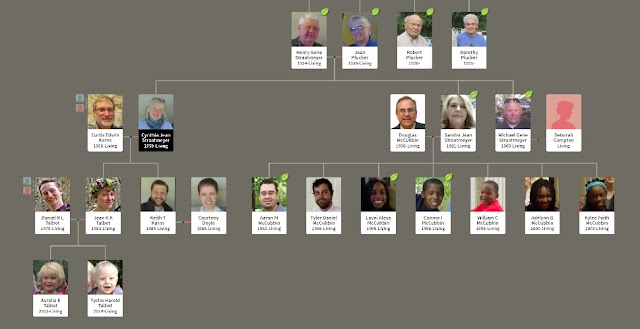
Gene and Jean are the parents of
Cynthia Jean, Sandra Jean and Michael Gene
Ralph and Hedina Margaret were brother and sister
Henry and Harmina (Minnie) were first cousins
Gertrude and Dena were second cousins
Gene and Jean are third cousins
Gene and Jean have common great-great grandparents
(Hedina and Ralph were brother and sister, Minnie and Henry were first cousins, Dena and Gertrude were second cousins and Jean and Gene are third cousins. The parents, Jurgen and Swantje, had Ralph, Thomas, Minnie (Mrs. Harm Buus), Mrs. John Geersma and George -- and perhaps more children.
Jean Plucker Straatmeyer (11/25/38 - 4/23/21) Born on a farm near Chancellor, SD.
Married Henry Gene Straatmeyer (b. 3/4/34) on 6/11/57.
In his “autobiography” called The Many Experiences Enjoyed by the Pluckers, M.E.J. Plucker writes the following: “One reason she was named Jean was because for a year or so before she was born there was a complicated musician’s strike going on that made it impossible for radio stations to play any kind of music except those numbers on which the copyright had run out. All of Stephen Foster’s songs were in this classification, so the song “I Dream of Jeanie With the Light Brown Hair” was usually heard several times a day. Also, the name Jean is the feminine counterpart of the name John, which was her grandfather’s name.”
Father: Menne Elvin (M.E.J.) Plucker, (8/4/00 - 10/19/68) The initials, “MEJ” were used because there were so many Menne Pluckers in the vicinity. Menne Elvin took his father’s first initial as his third, to make it easier for the mail carriers.
Born on a farm near Chancellor, SD
Married Dena Thaden on 6/4/24. Lived in Lennox, SD, Princeton, IL and Dubuque, IA before moving to “the home place” where M.E.J. was born.
Mother: Dena Margaret Thaden (Hendina Margaretta) (10/29/02 - _______ )
Born on a farm in the Lennox, SD vicinity, but moved to near Bryant, SD when she was just one year old -- the 5th of 11 children
Father’s side:
Grandfather: John Poppe Plucker
Great grandfather: Menne Albert Plucker (9/17/1837 - 8/25/25)
Born in Uttum, Ostfriesland -- Moved to America in 1868.
Great grandmother: Engel J. Poppens (8/12/1838 - 9/4/15)
Born in Suurhusen, Osfriesland
Menne & Engel were married 4/18/66 in Germany and emigrated to Rockford, ILL, relocated to Ackley, Iowa and in 1877, Menne came to Dakota Territory and filed a homestead claim six miles NW of Lennox. (They eventually gave the land for the church side (Germantown Presbyterian Church). M.E.J. Plucker writes in his “autobiography” the following:
“My grandfather accumulated quite a large empire before he finally quit buying and trading for more land. Before he distributed the land to his children, he owned 960 acres, all close to the Germantown church. At one time he was offered a 160 acre tract in exchange for one horse, but he couldn’t spare the horse.”
Grandmother: Christina Rebecca Witte -- (12/1/1872 - 12/29/1953) --born at Forestburg, IL. She came with her parents to Lennox in 1886. In 1889, the Witte family moved to Marion, SD. On Nov. 29, 1893, she married John P. Plucker. They had six children; one died as a child, one died as a young man.
M.E.J. writes in his book: “My mother’s father was not nearly as well known to me. He came to South Dakota in 1886 as the pastor of the newly organized Germantown church. I believe that it was his first experience as minister, and he was also the first pastor to serve Germantown. He was here for only a very short time.”
Great grandfather: Philip Witte (12/1/1837 - 9/11/1910) Died in Marion, SD and was buried in Germantown cemetery. He was the first pastor of Germantown Church.
Great grandmother: Anna Weimers (________ - 5/19/1878)
Mother’s side:
Grandfather: Eilert Ludwig (E. L.) Thaden (sometimes called “Louie)) (5/25/1870 - 12/24/62)
Born in Peoria, Ill. Died in Willow Lake, SD
E.L. and Minnie were married in 1897 and had 11 children. Before they married, E.L. lived in a sod house near Luverne, MN (perhaps with his folks) and in a claim shanty in Washington State, but didn’t stay long enough to earn title to the land. Ran out of money. He finished the 8th grade and earned a 3rd grade certificate to teach country school.
Great grandfather: Gerhert Ludwig Thaden (some said “Von Toden”)
Married:
Great grandmother: Johanna Christianna Amelia Wilkins in 1859
According to family oral history, they were in America in the 1860s. Gerhert had taught school in Germany and Amelia had been a musician -- played an organ (as did her father) in a “beautiful cathedral” in Aurich, East Friesland. Amelia composed “The Tacoma March” and a wedding march. They lived in Tacoma, Washington for 18 years moving there in 1891 after living 39 years in Grundy Center, IA and Luverne, MN.
This, from Dena’s “memoirs:”
This is some of the history of the Thaden family as told by my aunt who lived in Tacoma in 1966. She is the only one left of the generation of my father, in fact, she was married to my father’s brother. She told me my great grandfather, whose name was Wilkens, was the organist in a large cathedral in Germany. The Wilkens family belonged to the nobility. Evidently the Thadens were not of the nobility, because when my grandmother Wilkens married grandfather Thaden, she was disinherited because she married beneath her station in life. This could very well be the reason why grandfather Thaden decided to migrate to America. They settled first near Peoria, IL. Later they moved to Pipestone, MN and finally settled in Washington State in a small town near Tacoma.
Grandmother: Harmina (Minnie) Buus (10/24/1878 - 9/8/49)(She was 19 when they got married. She died of cancer of the liver.
Great grandfather: Harm Buus, born in 1847 in Ostfriesland and moved to America in 1863 with his parents.
Great grandmother: Hedina (Dena) Bossman -- (probably Hendina) (12/28/1850 - _____) (see Gene’s family notes)
Born in Ostfriesland Krus, Weener, Ostfriesland
Dirk Cirksena believes that Heddina Bossmann, who was born in Holthusen, Holthusen in 1850, is the sister of Tom, Harm and George Bossman. She married
Harm Buus. They had a total of 12 children. Their youngest child and daughter Minnie married Eilert Thaden and my wife Jean is their granddaughter. Jean's mother is named, Heddina after her grandmother, but as did her grandmother, she was known as just Dena. We have a copy of an old picture of the two taken by H. Saterbo in Lennox, SD.
This is where Jean and I are "cousins." We had common great great grandparents, the parents of Hedina, Thomas, Harm and George Bossman, whose names we do not have.
(Information received 9/15/97 shows that the parents of the above are:
Jurgen Bossmann (b. 4/16/1815, d. 2/5/1890) and
Swantje (Geersma) Bossman (no dates)
They were married 7/4/1838
**************************************************
From Gene's Diary about his wife:
I was a junior in college and she was a junior in high school when we first met. Her church had lost its pastor and I was asked to preach there several Sundays. We had been delivered by the same physician, in the same community, we had graduated from the same high school but we had never met before then.
I always had plenty of girl friends but something changed much of my life when as a sophomore in college I felt a call to the ministry. I dated girls who had no problem with me but had a big problem with my chosen profession should anything serious develop. Hometown girls knew me as the athlete who liked history and had asperations of being an athletic coach or an electrical engineer. Even church girls had reservations as I had with them. Young Christian girls very rarely say they want to marry a minister one day. Unbeknowns to me, that beautiful young girl in the front pew (her church was always packed then to the front pew) had that very aspiration. In his autobiography, her father said that was her goal as a young girl and she accomplished it. I call it a God-thing!
But she was young. So I waited for about six months when I noticed other young men interested in her. I had to act for fear of missing this what appeared to be a wonderful opportunity. She accepted and on January 30, 1955 this wonderful journey began of ‘forsaking all others.” Two and a half years later we were married in that country church where one of her great grandfathers was the first pastor of the church and the other great grandfather and mother had given the land for the original church and cemetery. We will be buried in that cemetery one day where these great grandparents lay.
We were fortunate as coupling goes. We had so much in common. Both of our early families were German immigrants from Ostfriesland in Northwestern Germany. Ostfriesland bordered on the North Sea and Holland. They came to the United States for a better life and eventually settled in the area of South Dakota where many other offspring of other Germans settled as well. We were a part of that German/American culture and we were both Christians heavily invested in the life and work of our churches. I went to a church of the same denominational in a nearby town. We were both comfortable in that denomination and have spent our whole lives serving it. So, before marriage, we both had professed our love for Christ and made commitments to serve Christ through the church.
My only early fear was that because she was close to her family, she might not want to go to areas of the country or the world if that call should come. While still loving her family, she never had problems with what is expressed in the Gospel hymn, “I’ll go where you want me to go dear Lord!’ The journey that began with dating in 1953 lead us to the states of Iowa, Minnesota, Arizona and Alaska. Eventually it led us to Malawi, Africa.
Our very comfortable and similar German cultural background made for a great foundation for the years ahead of us. Secondly, our Christian faith was such that marriage was not till we stopped loving one another but until death would end what “God had joined together.” When you never consider divorce in your marriage, then differences don’t take on the same significance. When you are in a Christian marriage relationship, the thought is more how to get through the difficult moments and move forward than the “Battle of the Bulge” where soldiers kept shooting at each other without making much progress.
Then, in Christian marriage, there is forgiveness. Forgiveness clears the slate. Forgiveness says you don’t want to pout about the past but you want to live again with joy and hope. But forgiveness also involves repentance. Repentance means change. Repentance means you can’t always be right and that you have to find the right for both of yours. That takes practice! That involves patience! That calls of digging down for the deep love that should have been developing in a marriage, acting as a resouvour that can kick in when extra love and caring is needed.
We grew up in a culture where children and adults were not separated when it came to worship or family. There were no nursuries in the churches we grew up in nor in the first two congregations we served. We grew up rubbing elbows with our elders, eating grandma’s cooking, listening to their stories, knowing our uncles and aunts and cousins because we often had Sunday dinner with them at grandma’s house on Sunday noon. That was the maturing and helping factor of our culture. Grandma’s tears and prayers touched us, even when we thought their concerns were old-fashioned and had nothing to say to our more modern American culture where we were shedding the old German way of life. We grew up in a larger cultural group and we learned that it does take a village and a community to raise a child. What a launch into adulthood.
In that culture we were expected to work, to do chores, to study hard, always the direction of the immigrant population. Our family wanted a better life for us than they had. Our families lived through the great depression and we lived through the end of it. We knew poverty and hard times. We made our own fun and spent a lot of time with our friends, in school, in church and community activities. And we grew to adulthood without many of obsticals modern youth has. We all had families and a community. Divorce was rare. We belonged to something bigger than ourselves. That made us strong inside and it gave us hope and vision for the future. It taught us, if not to love, to tolerate and respect those who were different than we were.
Comments
Post a Comment